
Commercial Flat Roof Replacement in Maine: What to Plan For
Updated November 16, 2026.
Direct Answer
A commercial flat roof replacement in Maine takes the roof down to the deck and rebuilds it to the 2021 energy code. With insulation above the deck, that means R-30 continuous insulation in Climate Zone 6, which covers Portland, Casco and Alfred [1][2]. Drainage, snow load, membrane and a warm-weather install window shape the rest.
TL;DR
- Tearing off a flat roof with insulation above the deck triggers Maine’s energy code: the new roof needs R-30 continuous insulation in Climate Zone 6 and R-35 in Zone 7 [1][2].
- A recover is an exception to that insulation rule, but the building code rules it out when the roof is wet, tile or slate, or already carries two roofs [3][4].
- On an existing low-slope roof, the code’s drainage test is water gone within 48 hours, not a set slope [5].
- Thicker insulation can hold more snow, and added layers or equipment add weight, so the structure gets checked before the design is final [6].
- Water-based and solvent-free EPDM bonding adhesives need 40°F or warmer, and Portland’s normal highs sit below or near that through March, so plan in January to April and install spring through fall [7][8][9].
- Roofs on nonresidential buildings can be elected as Section 179 property, with a $2,560,000 limit for 2026; confirm with your tax advisor [10].
One liner: Plan a Maine commercial flat roof replacement in winter around the R-30 insulation rule, then install once the weather clears 40°F.
In this article16 sections
- 01Key Numbers
- 02Commercial Flat Roof Replacement in Maine Starts Before Tear-Off
- 03Maine’s Energy Code Sets the Insulation on a Commercial Roof Replacement
- 04Tear-Off or Recover: What the Building Code Allows
- 05Membrane Options: EPDM, TPO and What Maine Winters Favor
- 06Drainage: Slope, Drains and Ponding Water
- 07Structure and Snow Load Before Adding Weight
- 08Scheduling a Commercial Roof Replacement Around Your Business
- 09The Best Season to Book Commercial Flat Roof Replacement in Maine
- 10Budgeting: Cost Drivers and the Section 179 Deduction
- 11Choosing Commercial Flat Roofing Contractors in Maine
- 12Plan Your Commercial Roof Replacement in Maine
- 13Frequently Asked Questions
- 14Definition Bank
- 15Quick Facts
- 16Sources
Key Numbers
| Stat | What it measures | Source |
|---|---|---|
| R-30ci | Minimum insulation for a roof replacement with insulation above the deck, Climate Zone 6 | Polyisocyanurate Insulation Manufacturers Association (PIMA), 2025 [2] |
| R-35ci | Same requirement in Climate Zone 7 (Aroostook County) | Polyisocyanurate Insulation Manufacturers Association (PIMA), 2025 [2] |
| April 7, 2025 | MUBEC moved to the 2021 codes | Maine Office of the State Fire Marshal, 2025 [11] |
| R-5.7 per inch | Polyiso insulation, per GAF | GAF [12] |
| 1/4 inch per foot | Minimum slope for most membranes on a new roof | 2021 International Building Code, 2021 code [4] |
| 48 hours | Time a roof must drain to count as positive drainage | 2021 IBC, via IIBEC, 2026 [5] |
| 21 pounds per square foot | Weight of one foot of wet, heavy snow | FEMA P-957, 2013 [6] |
| 40°F | Minimum application temperature for Carlisle’s water-based and Elevate’s solvent-free EPDM bonding adhesives | Carlisle; Elevate [8][7] |
| 32.4°F | Portland’s normal January high | National Weather Service, 1991 to 2020 normals [9] |
| $2,560,000 | Section 179 limit for tax years beginning in 2026 | IRS Publication 946, 2026 [10] |
| April 29, 2026 | LD 1226 contractor licensing bill died on adjournment | Maine Legislature, 2026 [13] |
Commercial Flat Roof Replacement in Maine Starts Before Tear-Off
In short: A commercial flat roof replacement takes the roof down to the deck and rebuilds it, and since April 7, 2025 Maine’s 2021 codes decide much of what goes back on.
It usually starts with a bucket. A drip shows up over the stockroom in February, someone patches the seam, and by March the stain is back two bays over. By the time the roof lands on the spring budget, most owners want to know one thing: what does replacing it involve?
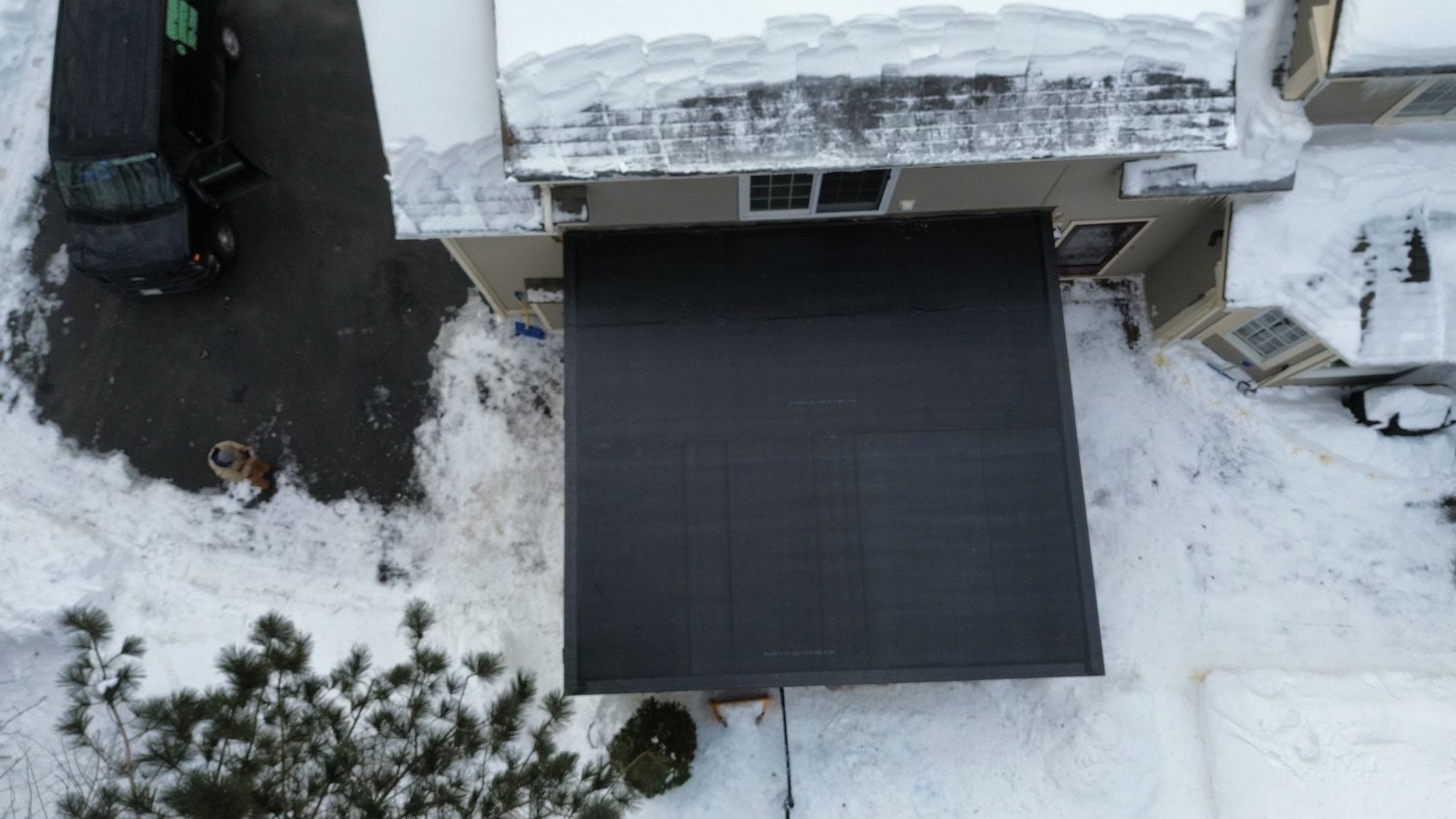
A commercial flat roof replacement takes the old roof off down to the deck, then builds a new one back up with insulation, membrane, flashing and drainage. The layers under the membrane need as much planning as the membrane on top. The Maine Uniform Building and Energy Code (MUBEC) moved to the 2021 code editions on April 7, 2025 [11], and that changed what has to go under a new commercial roof.
Our team at Superior Roofing works on flat and low-slope roofs from offices in Portland, Casco and Alfred. Most of the commercial roof replacement Maine owners ask us about comes down to the same handful of choices: insulation, tear-off or recover, membrane, drainage, snow load, scheduling, season and budget. We cover each one below. If your building already has an ethylene propylene diene monomer (EPDM) roof, that’s a membrane we install.
The sections below follow the order a project runs in:
- Assess the roof and make test cuts
- Design the insulation and drainage to code
- Check the structure for added weight and snow
- Compare bids and sign a written contract
- Tear off and install in sections, sealed each day
- Final inspection and warranty paperwork
Maine’s Energy Code Sets the Insulation on a Commercial Roof Replacement
In short: Tear off a flat roof with insulation above the deck and Maine’s energy code requires new-building insulation, R-30 continuous in Climate Zone 6.
When a flat roof with insulation above the deck is torn off, Maine’s energy code treats the new roof like new construction. In Climate Zone 6, which takes in Portland, Casco and Alfred, that means R-30 continuous insulation, not whatever thickness came off [14][1][2].
The rule sits in Section C503.2.1 of the 2021 International Energy Conservation Code (IECC). Maine adopted that code for commercial buildings and left its existing-building chapter unchanged [11][14]. C503.2.1 points roof replacements back to the new-building insulation tables whenever the roof has insulation entirely above the deck, and it says that “in no case” may the roof’s R-value go down [1]. The Polyisocyanurate Insulation Manufacturers Association (PIMA) lists the Maine minimums as R-30ci in Climate Zone 6 and R-35ci in Climate Zone 7 [2]. Most of Maine is in Zone 6, while Aroostook County is in Zone 7 [15][16].
That’s often a thicker build-up than an older roof carries. GAF lists polyisocyanurate (polyiso), the board under most commercial membranes, at about R-5.7 per inch [12]. At that rate, R-30 works out to a bit over 5 inches. A taller roof surface means curbs, wall flashing, drains, edge metal and door thresholds all get checked against the new height before material is ordered.
| Roof work | Does the new-building insulation level apply? | Source |
|---|---|---|
| Tear-off of a roof with insulation entirely above the deck | Yes: R-30ci in Zone 6, R-35ci in Zone 7 | [1][2] |
| Roof recover, a new membrane over the existing roof | No, roof recovering is listed as an exception | [3] |
| Membrane replacement where the insulation sits below the deck | No, this is a separate exception | [3] |
The code also allows other ways to show compliance, including ASHRAE 90.1-2019, which Maine adopted alongside the IECC [17]. Where a curb, parapet or door sill leaves no room for the full thickness, ASHRAE says the local authority having jurisdiction decides how to handle it [3]. Your town’s code enforcement office is the place to start that conversation. Before you compare bids, ask each one what R-value goes back on, how thick the insulation runs at the drains and the high points, and which curbs or flashings have to be raised to fit it.
Tear-Off or Recover: What the Building Code Allows
In short: A recover goes over the old roof and a replacement goes to the deck. The code rules out a recover on a wet roof, a tile or slate roof, or a building that already has two roofs.
Most replacements start with one of three findings: leaks that keep coming back in new spots after repairs, test cuts that turn up wet insulation, or a membrane past the warranty term it was sold with [18].
The building code gives a flat roof two paths. A roof replacement takes every existing layer off down to the deck. A roof recover puts a new roof over the old one [4]. The choice usually gets made for you by what’s under the membrane.
The 2021 International Building Code (IBC), part of MUBEC since April 7, 2025 [11], doesn’t allow a recover in three cases [4]:
- The existing roof is water-soaked or has deteriorated to the point it can’t support a new one
- The existing covering is slate, clay tile, cement tile or asbestos-cement tile
- The building already has two or more roofs on it
The first condition is the one to check early. Wet insulation is hard to spot from the roof surface, but a few test cuts through the membrane show whether the boards underneath are dry, and that answer usually picks the path.
| Roof replacement (tear-off) | Roof recover | |
|---|---|---|
| What comes off | Everything down to the deck | Nothing, the new roof goes over the old one |
| Deck | Exposed, so soft or rusted spots can be repaired | Stays hidden under the old roof |
| Energy code insulation | New-building level, R-30ci in Zone 6 [1][2] | Listed as an exception [3] |
| Weight on the structure | Old layers come off before new ones go on | New layers add to what’s already there |
| Ruled out when | Not ruled out | Roof is wet or deteriorated, tile or slate, or already two roofs [4] |
Take two buildings side by side. One has a single dry roof over a sound deck, so a recover is on the table. The other already carries two roofs, so the code sends it to a full tear-off no matter what the bids say.
Membrane Options: EPDM, TPO and What Maine Winters Favor
In short: EPDM and TPO are the two single-ply membranes most owners compare. EPDM’s stretch and cold flexibility suit Maine winters, and it’s a membrane we install.
Holcim Elevate, which makes both, calls EPDM and thermoplastic polyolefin (TPO) two popular single-ply membranes for flat and low-slope roofs [19]. EPDM is a synthetic rubber sheet, and TPO is a white plastic sheet. Think of EPDM as an inner tube joined with tape, and TPO as a pouch with its seams melted shut.
| EPDM | TPO | |
|---|---|---|
| How seams join | Self-adhesive seam tape [19] | Heat-welded [19] |
| Stretch | Up to 300% in all directions, per Holcim Elevate [19] | Not stated by the maker |
| Cold weather | Flexibility rated at -40°F, per Carlisle [18] | Gets more rigid in cold, per Holcim Elevate [7] |
| Surface | Black, with carbon black for UV resistance [19] | Usually white or light colored [19] |
| Service life, as the maker states it | “Can exceed 50 years” [19] | 20 to 30 years for a high-quality system [19] |
Holcim Elevate ties TPO’s white surface to lower cooling costs in warm regions on buildings with little insulation [19]. A Maine roof built to R-30 is the opposite case on both counts. For a roof that goes through Maine freeze-thaw cycles, EPDM’s stretch and cold flexibility are the specs to look at.
We install EPDM on flat roof replacement work. You can read more about our rubber roofing services.
Both membranes can be fully adhered with bonding adhesive, mechanically attached with plates and fasteners, or held down with ballast [19]. The attachment method affects the roof’s weight and the weather it can be installed in, so ask about it alongside the warranty. Carlisle offers warranties of up to 25 years on 45-mil and up to 30 years on 60-mil non-reinforced EPDM [26], and the term you get depends on the system and how it’s installed.
Drainage: Slope, Drains and Ponding Water
In short: On an existing roof, the code asks for positive drainage, meaning the roof drains within 48 hours, rather than a fixed 1/4 inch per foot.
A common line in flat roof guides is that the code requires 1/4 inch of slope per foot. For a new roof, the 2021 IBC does set that minimum for most membranes [4]. For a replacement or recover on an existing low-slope roof, the test changes to positive roof drainage instead [4][5].
The code defines positive roof drainage as a design that accounts for deflection under all design loads and has enough slope that the roof drains within 48 hours of precipitation [5]. In plain terms, if water is still sitting on the roof two days after a storm, the roof isn’t draining the way the code means. Ponding water is the problem to solve, whatever the slope number turns out to be.
| New roof on a new building | Replacement or recover on an existing roof | |
|---|---|---|
| Minimum slope | 1/4 inch per foot for most membranes [4] | Not required where the roof has positive drainage [4][5] |
| Secondary (overflow) drains or scuppers | Required where parapets or raised edges would trap water [4] | Not required to be added where the roof has positive drainage [5] |
| Existing overflow drains | Not applicable | Can’t be removed unless replaced with code-compliant ones [4] |
Most of the fix happens in the insulation layer. For scale, 1/4 inch per foot works out to about 1 inch of fall over 4 feet. Tapered insulation boards build that fall in toward each drain or scupper, and crickets, small sloped ridges, steer water around curbs and between drains. Those tapered boards sit in the same layer that has to meet the insulation requirement above, so drainage and insulation get designed together.
When you walk the roof with a bidder, point out where water collects after rain and ask how the tapered layout moves it to the drains. Photos taken the day after a storm help, since they show exactly where the puddles sit.
Structure and Snow Load Before Adding Weight
In short: Added layers, ballast and new equipment add weight, and thicker insulation can hold more snow, so the structure gets checked before the design is final.
A new roof changes the load on the building in two ways: what the roof weighs and how much snow it holds. The Federal Emergency Management Agency (FEMA) Snow Load Safety Guide covers both. It says a reroof that adds weight reduces the structure’s capacity to carry snow, and that thicker or more efficient insulation may increase snow retention [6]. On a Maine roof getting the code’s thicker insulation, both points apply at once.
| What changes in the replacement | Effect on the structure | Source |
|---|---|---|
| A recover over the existing roof | Adds weight, which reduces the capacity left for snow | [6] |
| Thicker or more efficient insulation | Can keep more snow on the roof | [6] |
| New or relocated rooftop units | Add weight and collect drifting snow | [6] |
| A ballasted membrane | Holds the roof down with gravel or concrete pavers | [19] |
Snow depth alone doesn’t tell you the load. FEMA puts a foot of light, dry snow at about 3 pounds per square foot and a foot of wet, heavy snow at about 21 [6]. That’s the difference between a January powder and the same depth soaked by a March rain. Drifts pile deeper still against parapets, roof steps and rooftop units [6].
Under MUBEC, the design snow load for a building is looked up by its exact address in the American Society of Civil Engineers (ASCE) Hazard Tool, using ASCE 7-16 [20]. If the replacement adds weight, moves equipment or raises the insulation, ask for that structural check before the design is final. For Portland’s snow load limits and winter roof safety, see our guide to roof snow load.
Scheduling a Commercial Roof Replacement Around Your Business
In short: Commercial roofs are worked in sections and sealed each day, so most businesses keep running; the phasing, intakes and access get settled before day one.
Picture a restaurant with its kitchen exhaust and makeup air units sitting on the section of roof that’s coming off. The roof work and the dinner service have to fit around each other, and that gets settled before the first day, not on it.
Carlisle notes that most commercial roof projects are too large to finish in one day, so each day’s completed work gets sealed off until the crew comes back [21]. In practice, the roof comes off one section at a time, and only as much as can be covered again before evening. The rest of the building keeps working under the old roof or the new one.
Smell is the other common worry, since adhesive fumes can be drawn into the building through rooftop air intakes. Carlisle markets a self-adhering EPDM with a low-VOC adhesive it says eliminates jobsite odors, and it calls that membrane a strong fit for occupied buildings [22]. Ask which adhesives and primers the bid uses and how they’ll be kept away from your fresh air intakes.
Before commercial flat roof replacement services start, settle these with your roofer:
- The order the roof sections come off, and which rooms or tenants sit under each one
- Which rooftop units and fresh air intakes need to be shut down, covered or moved, and for how long
- Where the dumpster, material deliveries and any crane or lift go, and what that does to parking and entrances
- Quiet hours or days for noisy tear-off over offices, clinics or retail floors
- One contact on each side for daily updates and anything that comes up overnight
The Best Season to Book Commercial Flat Roof Replacement in Maine
In short: Water-based and solvent-free EPDM bonding adhesives need 40°F or warmer, and Portland’s highs reach that by April, so January to April is for planning and spring through fall is for installing.
Adhered EPDM has a temperature floor, and in Maine that floor sets the calendar. Carlisle lists a 40°F minimum application temperature for its water-based Aqua Base 120 EPDM bonding adhesive [8]. Holcim Elevate says to use its solvent-free EPDM adhesive only above 40°F, and not when temperatures are expected to drop below freezing within 12 hours [7].
Now set that against Portland’s weather. The National Weather Service puts Portland’s normal daily high at 32.4°F in January, 35.0°F in February and 42.3°F in March, before it climbs to 53.8°F in April [9]. A normal January high sits nearly 8 degrees below that floor.
| Window | What to get done | Why it falls here |
|---|---|---|
| January to April | Budget, test cuts, bids, insulation and drainage design, code office questions | Normal highs sit near or below 40°F through March [9], so it’s planning time |
| Spring through fall | Tear-off and install | Highs clear the adhesive floor, starting with a 53.8°F normal high in April [8][9] |
| Late fall and winter | Repairs, emergency patches, work that cold-weather products allow | Elevate’s cold-weather procedures apply below 40°F, and its self-adhered membranes go down above 20°F [7] |
Winter work isn’t ruled out. Manufacturers publish cold-weather procedures, and some self-adhered products are rated for lower temperatures [7]. A fully adhered tear-off in February has to follow those procedures from start to finish.
The planning gap is the part owners feel. A contract signed in March can line up design, materials and a crew for the first warm stretch. A call made in October after a leak lands in the cold-weather window, so a repair usually carries the roof to spring.
Budgeting: Cost Drivers and the Section 179 Deduction
In short: Compare bids line by line on tear-off, wet insulation, insulation to code, curbs, drains, membrane and season, and ask your accountant about Section 179.
A real price needs a look at the roof, and national per-square-foot averages don’t account for Maine’s insulation rule or a winter schedule. What you can do is know which lines move the price, so two bids can be compared line by line.
| Line item | Why it moves the price |
|---|---|
| Tear-off and disposal | More existing layers mean more labor and more dumpster loads |
| Wet insulation and deck repair | Found with test cuts; soft or rusted deck sections get replaced before the new roof goes on |
| Insulation to code, including tapered boards | The code-required R-value sets the thickness, and tapered layouts add material at the high points |
| Raised curbs, wall flashing and edge metal | A thicker roof can mean taller curbs and new metal at the edges |
| Drains and overflow | Moving drains, adding sumps or replacing overflow scuppers |
| Membrane, attachment and warranty | Fully adhered, fastened or ballasted systems price differently, and the warranty term depends on the system and how it’s installed |
| Rooftop units and access | Disconnects, curbs, crane or lift time, and work around occupied spaces |
| Season | Cold-weather procedures add time and limit which products can be used |
A bid that lists the R-value, the insulation thickness at the drains and the attachment method tells you what you’re buying. A bid that says “new rubber roof” doesn’t.
The other budget line is tax timing. The IRS counts roofs on nonresidential buildings as qualified real property for the Section 179 deduction, as long as the roof is placed in service after the building itself was [10]. For tax years beginning in 2026, the Section 179 limit is $2,560,000, reduced once qualifying property placed in service tops $4,090,000 [10]. We’re roofers, not tax advisors, so take the project scope to your accountant before the budget is final.
Choosing Commercial Flat Roofing Contractors in Maine
In short: Maine doesn’t license roofers, so ask every bidder the same questions on R-value, wet insulation, drainage, warranty, daily protection and insurance.
Maine doesn’t license roofing contractors at the state level. LD 1226, a bill to license residential building contractors, died on adjournment on April 29, 2026 [13]. On a commercial job, the checks fall to you and your bid documents, so it helps to ask every bidder the same questions.
| Ask | A complete answer includes |
|---|---|
| What R-value goes back on, and how thick is it at the drains? | A number, such as R-30ci, plus thickness at the low and high points |
| How will you find wet insulation? | Test cuts before the price is final, and what happens if more turns up |
| How does the tapered layout drain the roof? | A drawing showing slope to each drain and the crickets around curbs |
| Who backs the warranty? | The membrane maker, the warranty term and whether the installer is approved for it |
| How do you protect the building overnight and keep fumes out? | A daily seal and a plan for rooftop intakes |
| Do you carry workers’ compensation? | A certificate of coverage from the insurer |
| Does this job need a building permit, and who applies? | Your town’s answer, and the bidder’s name on the application if one is needed |
| Who signs off at the end? | A final inspection, and for a manufacturer system warranty, the maker’s own inspection before the warranty is issued [23] |
On the warranty question, Carlisle’s sample system warranty covers the workmanship of its Carlisle Authorized Roofing Applicator [24], so the installer’s status with the maker is part of what you’re buying. On insurance, the Maine Bureau of Insurance says the law requires almost all employers to carry workers’ compensation [25].
Compare two answers to the first question. One contractor says R-30ci, tapered to the drains, with curbs raised to match. Another says “we’ll put a new rubber roof on.” Only the first one has priced the job Maine’s energy code describes.
Plan Your Commercial Roof Replacement in Maine
In short: Plan in winter, gather your roof history and photos, and call our Portland office at 207-702-7663 for a free estimate.
The best time to plan a commercial roof replacement in Maine is while there’s still snow on it. A winter visit gives time for test cuts, an insulation and drainage design, and a bid you can take into your budget meeting, so the work is ready to start when the weather turns.
Before you call, gather what you have: the roof’s age, past repairs, photos of where water sits after a storm, a list of rooftop units, and your business hours and any tenants under the roof. Our team handles commercial roofing in Portland from our office at 525 Riverside St, with offices in Casco and Alfred for the rest of southern Maine. Estimates are free.
Call 207-702-7663 to set up a look at your roof.
Frequently Asked Questions
In short: Short answers on insulation, recovers, staying open, membranes and timing.
Do I have to add insulation when I replace my commercial flat roof?
Usually, yes. If the roof has insulation above the deck and it comes off, Maine’s energy code requires the new roof to meet new-building levels, R-30 continuous insulation in Climate Zone 6 and R-35 in Zone 7 [1][2]. A recover over the existing roof is treated as an exception [3]. Ask every bidder to put the R-value and thickness in writing.
Can you put a new roof over my old flat roof?
Sometimes. The building code allows a recover only when the existing roof is dry and sound, isn’t slate or tile, and the building doesn’t already have two roofs [4]. Test cuts show whether the insulation is dry. If it’s wet, the roof comes off to the deck.
Can my business stay open during the roof replacement?
In most cases, yes. Commercial roofs are worked in sections, and each day’s work gets sealed before the crew leaves [21]. The order of sections gets planned around your hours and tenants, along with which rooftop units and fresh air intakes need to be shut down or covered.
Is EPDM or TPO better for a flat roof in Maine?
Both are single-ply membranes, and they differ in seams and surface. EPDM seams are taped and TPO seams are heat-welded [19]. Carlisle rates its EPDM’s flexibility at -40°F [18], while Holcim Elevate notes TPO gets more rigid in the cold [7]. We install EPDM and can talk through both for your building.
When should I book a commercial flat roof replacement in Maine?
Plan and sign in January to April, and install in spring through fall. Water-based and solvent-free EPDM bonding adhesives from Carlisle and Holcim Elevate need at least 40°F [7][8], and Portland’s normal highs stay below or near that through March [9]. Winter is the time for test cuts, bids and design.
Definition Bank
| Term | Meaning |
|---|---|
| Roof replacement | Removing all existing roof layers down to the deck and installing a new roof. |
| Roof recover | Installing a new roof over the existing one without tearing it off. |
| Insulation entirely above deck | Rigid insulation boards laid on top of the structural roof deck, under the membrane. |
| Continuous insulation (ci) | Insulation that runs unbroken across the roof, without framing interrupting it. |
| R-value | A measure of how well insulation resists heat flow. Higher is better. |
| Polyiso | Polyisocyanurate, the rigid foam board used under most commercial membranes. |
| Tapered insulation | Insulation boards cut to a slope so water runs toward drains or scuppers. |
| Cricket | A small sloped ridge that steers water around curbs or between drains. |
| Positive roof drainage | A roof designed to drain within 48 hours of precipitation, allowing for deflection. |
| Ponding water | Water left standing on a low-slope roof after it should have drained. |
| Secondary (overflow) drain | A backup drain or scupper that carries water off if the main drains clog. |
| Scupper | An opening through a parapet or roof edge that lets water off the roof. |
| EPDM | Ethylene propylene diene monomer, a synthetic rubber single-ply membrane with taped seams. |
| TPO | Thermoplastic polyolefin, a white single-ply membrane with heat-welded seams. |
| Daily seal | A temporary seal at the edge of each day’s roofing so the building stays dry overnight. |
| Authority having jurisdiction | The local official who interprets and enforces the code for a project. |
| MUBEC | The Maine Uniform Building and Energy Code, based on the 2021 I-codes since April 7, 2025. |
| Section 179 | A federal tax election to deduct qualifying property in the year it’s placed in service. |
Quick Facts
2021 IECC Section C503.2.1, Roof replacement
| Property | Value |
|---|---|
| Applies to | Roof replacements where the roof has insulation entirely above the deck [1] |
| Requirement | Meet the new-building insulation rules; R-value may not go down [1] |
| Climate Zone 6 minimum | R-30ci [2] |
| Climate Zone 7 minimum | R-35ci [2] |
| Exceptions | Roof recovering; membrane replacement with insulation below the deck [3] |
| In force in Maine | April 7, 2025, through MUBEC [11] |
MUBEC
| Property | Value |
|---|---|
| Full name | Maine Uniform Building and Energy Code |
| Code editions | 2021 IBC, IEBC, IRC, IECC and IMC; ASHRAE 90.1-2019 [11] |
| Effective | April 7, 2025 [11] |
| Snow load lookup | By exact address in the ASCE Hazard Tool, ASCE 7-16 [20] |
EPDM roof membrane
| Property | Value |
|---|---|
| Seams | Self-adhesive tape [19] |
| Stretch | Up to 300%, per Holcim Elevate [19] |
| Cold flexibility | Rated at -40°F, per Carlisle [18] |
| Adhesive minimum temperature | 40°F for Carlisle’s water-based and Elevate’s solvent-free adhesives [7][8] |
| Warranties | Up to 25 years on 45-mil and 30 years on 60-mil Carlisle non-reinforced EPDM [26] |
Section 179 qualified real property
| Property | Value |
|---|---|
| Includes | Roofs, HVAC, fire protection and alarm, and security systems on nonresidential buildings [10] |
| Condition | Placed in service after the building was first placed in service [10] |
| 2026 limit | $2,560,000 [10] |
| 2026 phase-out starts | $4,090,000 of qualifying property [10] |
Superior Roofing
| Property | Value |
|---|---|
| Offices | Portland, Casco and Alfred |
| Portland office | 525 Riverside St, Portland, ME 04103 |
| Phone | 207-702-7663 |
| Work | Residential and commercial roofing; repair and replacement |
| Estimates | Free |
Sources
- International Code Council, 2021 International Energy Conservation Code, Chapter 5 (CE) Existing Buildings, Section C503.2.1
- Hunter Panels with the Polyisocyanurate Insulation Manufacturers Association, Maine Energy Code Fact Sheet (June 4, 2025)
- ASHRAE, Interpretation IC 90.1-2019-14, Section 5.1.3 Envelope Alterations (January 30, 2024)
- International Code Council, 2021 International Building Code, Chapter 15 Roof Assemblies and Rooftop Structures (Sections 1502.2, 1507, 1512)
- Jason P. Wilen, IIBEC, Finding Balance: The Next Chapter in Low-Slope Roof Design (March 27, 2026)
- Federal Emergency Management Agency, FEMA P-957 Snow Load Safety Guide (January 2013)
- Elevate (formerly Holcim Elevate), Cold Weather Application Guidelines 2026-2027 (November 2026)
- Carlisle SynTec, Carlisle Adhesives chart, minimum application temperatures
- National Weather Service, Gray/Portland office, Portland climate normals 1991 to 2020
- Internal Revenue Service, Publication 946, How To Depreciate Property (2025 returns, published March 13, 2026)
- Maine Office of the State Fire Marshal, Maine Building Codes FAQ (2025)
- GAF, via BNP Media, Go with the Flow: Tapered Insulation Fundamentals
- Maine Legislature, LD 1226, An Act to Protect Consumers by Licensing Residential Building Contractors, 132nd Legislature
- Maine Department of Public Safety, 16-642 C.M.R. ch. 6, Energy Code (amended March 4, 2025)
- Tux Turkel, The Maine Monitor, in the Portland Press Herald, Maine is getting a new energy code, and it’s a stretch (March 9, 2025)
- The Maine Monitor, republished by CentralMaine.com, Maine energy code coverage (2025)
- U.S. Department of Energy, Building Energy Codes Program, Maine status
- Carlisle SynTec, Sure-Seal EPDM Dusted Non-Reinforced Membranes, Product Data Sheet (June 1, 2017)
- Holcim Elevate, The EPDM vs. TPO debate
- Maine Office of the State Fire Marshal, MUBEC Snow Loads (November 2025)
- Carlisle SynTec, A Daily Seal for Roofing Projects (June 17, 2020)
- Carlisle SynTec, SpecTips: Carlisle’s 5’ SAT EPDM (April 16, 2025)
- Carlisle SynTec, Sure-Seal Fully Adhered Roofing System, Product Data
- Carlisle SynTec, Golden Seal Total Roofing System Warranty (sample)
- Maine Bureau of Insurance, An Employer’s Guide to Workers’ Compensation Insurance in Maine
- Carlisle SynTec, SpecTips: New Extended Warranty Options for EPDM (October 8, 2024)